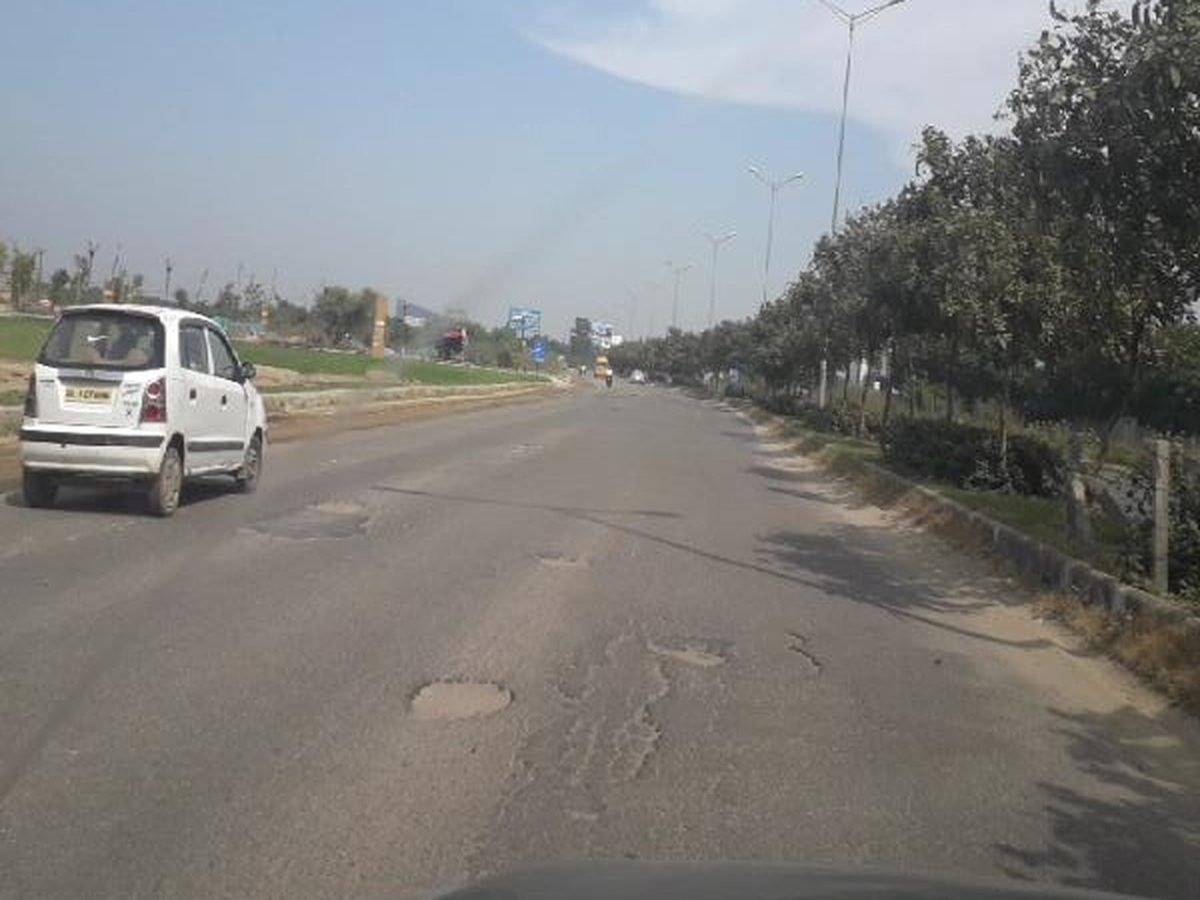
A frame the model never trained on
People's labels, then the live model's output
 D40D40D40D40D20D0080%74%71%59%46%39%
Model card Road damage detector
A plain account of what Poth's detector was trained on, how it scores, and its limits. Version 0.2 learned from 8,834 more Indian road frames and now scores higher on Indian roads it never saw.
Locked Indian test set, 1,150 frames never used in training · v0.2 against v0.1 · threshold 0.35
We fine-tuned v0.1 on 8,834 new Indian frames from two public sets, with the Indian training set shown twice as often. Frames close to any test frame were removed first, so the test stays unseen.
+6.6 points on transverse cracks, the hardest class
+1.4 points overall on the Indian test
−0.8 on the seven-country set, a small trade for local accuracy
mAP@50, 1,150 held-out Indian frames
People's labels, then the live model's output
D40D40D40D40D20D0080%74%71%59%46%39%Validation score after each epoch
Rose fast, then flattened after epoch 12
Labelled defects in training
D0026,016D1011,830D2010,616D406,54455,006 labels on 38,385 images, plus 24,946 Indian labels in v0.2
Indian frames, split in blocks of 50
Used once, for the final score
Today's scores come from a public, multi-country dataset, so there is real room to improve. With investment, we will build a road-damage dataset native to Assam, giving higher scores on the roads that matter and a result agencies can trust.
Public data, seven countries. Indian test mAP@50 45.2%.
Fine-tuned with 8,834 more Indian frames. Indian test 46.6%.
Fine-tuned on an Assam dataset, scored on Assam roads it never saw.
1,000+ km driven across Guwahati, Dibrugarh, Tinsukia and rural roads
Every season dry, monsoon-wet and patched surfaces
Labelled with engineers using the same four damage classes
A locked Assam test set split by road stretch, scored once, published
Training data: RDD2022, Arya et al., 2024, CC BY 4.0 · Base model: RF-DETR (Apache-2.0)
Screening road networks for cracks and potholes from routine drives
Prioritising inspection so engineers start where damage is worst
Checking repairs by comparing one drive with the next
Final decisions without review. Low-confidence finds go to an engineer.
Identifying people or vehicles. Faces and plates are blurred before storage.
Night, flooded or snow-covered roads. Too few training examples to trust.
Few Indian cracks yet. v0.2 added 8,834 Indian frames, but 95% of their labels are potholes, and none come from the North East.
Cracks get called potholes. On close-up damage the classes blur; see the frame above.
Thin transverse cracks are hardest. They are the smallest class in the data and easily confused with joints and shadows.
Scores are per frame. A defect seen across several frames is far less likely to be missed than recall suggests.
Share one route's footage. Get every defect on it, boxed, classed and mapped.